• Latest
  • Trending
National Testing Agency NTA Limb development in a nutshell

Limb development in a nutshell

February 19, 2026

NEET PG Free Tests

December 30, 2025
The Ultimate FMGE Final 7 Days Strategy (2025): A Data-Driven Blueprint for Guaranteed Success

The Ultimate FMGE Final 7 Days Strategy (2025): A Data-Driven Blueprint for Guaranteed Success

December 13, 2025
Ultra-High-Yield One Liners

Ultra-High-Yield One Liners

December 13, 2025
FMGE 2025 High-Yield Clinical Vignettes: One-Line Diagnosis & Immediate Management

FMGE 2025 High-Yield Clinical Vignettes: One-Line Diagnosis & Immediate Management

December 13, 2025
FMGE 2025 Last-Minute Flowcharts & Tables You Must Memorize

FMGE 2025 Last-Minute Flowcharts & Tables You Must Memorize

December 13, 2025
fmge-7-days-study-plan

FMGE 2025: What to Read in the Last 7 Days & Final 48 Hours

December 13, 2025
Important Questions For FMGE Series

Important Questions For FMGE Series

December 13, 2025
FMGE December 2017 Full Recall Part 1

FMGE December 2017 Full Recall Part 1

December 13, 2025
FMGE June 2018 Full Recall Part 1

FMGE June 2018 Full Recall Part 1

December 13, 2025
FMGE Dec 2018 Full Recall Part 1

FMGE Dec 2018 Full Recall Part 1

December 13, 2025
FMGE RECALL JUNE 2019

FMGE RECALL JUNE 2019

December 13, 2025
FMGE RECALL DEC – 2019

FMGE RECALL DEC – 2019

December 13, 2025
  • About
  • Advertise
  • Privacy & Policy
  • Contact
Sunday, March 8, 2026
DMA Edu
  • Home
  • About
    • TEAM
    • FACULTIES
    • PARTNERS
  • Exams
    • INDIA
      • FMGE
      • NEET-UG
      • NEET PG
      • NExT
    • ABROAD
      • PLAB
      • USMLE
      • SMLE
      • DHA
  • Courses
  • Products
    • FMGE APP
    • NEET-PG APP
    • USMLE APP
    • DHA APP
  • FREEBIES
    • RESOURCES
    • TESTS
    • APPS
      • FMGE APP
      • NEET-PG APP
      • USMLE APP
      • DHA APP
  • Daily
No Result
View All Result
DMA Edu
No Result
View All Result
Home Embryology

Limb development in a nutshell

by siva guru
February 19, 2026
in Embryology, Genetics, Pediatrics, Pre-Clinical
249 13
0
509
SHARES
1.5k
VIEWS
Share on FacebookShare on Twitter

Limb development timeline:

  • Starts in: 4th week (Upper limb initiated 3-4 days before and stays ahead of the lower limb)
  • Finished by: 8th week

2c Limb development in a nutshell

Limb Buds initiation:

  • Limb bud is mesenchyme covered by ectoderm (end of 4th week)
  • Source of limb components:
    1. Lateral plate mesoderm/LPM (somatic)→bone, connective tissue, vasculature
    2. Paraxial mesoderm (somite-derived)→muscle (myotome)
    3. Neural tube: motor and sensory neurons
    4. Surface ectoderm: epidermis
    5. Neural crest: melanocytes
  • Structure  & formation of limbbuds:
    1. Form from somatic lateral plate mesoderm
    2. Edge of bud the apical ectodermal ridge (AER)→critical for limb formation
    3. Within the limb bud are the progress zone (high proliferation) and the mesenchymal mesoderm (stop dividing, differentiate into proper proximal/distal fate)
  • Molecular limb embryology:
    1. Intermediate mesoderm→ FGF8 (mitogen)→ ↑ LPM to proliferate→ Induces Limb bud
    2. FGF8→initiates Apical Ectodermal Ridge (AER)
    3. AER releases FGF8→ stimulates growth in progress zone→ controls where the limb forms along the A/P axis of the body
  • Limb axes: Limb axes are unusual: anterior (thumb), dorsal (back of the hand), distal (fingers)
Development of the three limb axes
  1. Proximal/Distal Axis
  • AER (apical ectodermal ridge) formed by ectodermal thickening
  • Influences underlying mesenchyme to proliferate (progress zone)
  • Mesenchyme differentiates first furthest from AER
  • Control of P/D differentiation: Pattern of HOX genes (more distally)
2. Anterior/Posterior Axis
  • Control of A/P patterning: zone of polarizing activity (ZPA) is the mesenchymal tissue in the posterior limb bud is responsible
  • Shh gradient:
    1. ZPA produces Shh which acts as a morphogen
    2. Gli3 repressor gradient (highest in anterior) → Gli is cleaved into the active form in absence of Shh
    3. Shh receptor (Ptc) is also distributed in a graded manner
3. Dorsal/Ventral Axis
  • Wnt-7a from dorsal limb bud ectoderm→ induces Lmx-1 in dorsal limb mesenchyme,→dorsalizes limbOn the ventral side: EN-1 (from ectoderm) represses WNT-7a expression → hence Lmx-1 is inactive and the limb is centralized
  • The pattern signaling of Shh, Wnt-7a, and FGF are codependent and integrated
  • Forelimb/hindlimb:
    1. Leg expresses: Pitx1 and Tbx4 txn factors (controlled by Hox-c genes)
    2. Arm expresses: Tbx5 which inhibits Tbx4
  • Digits formation:
    1. AER delineates where digits will form.
    2. ZPA & SHH determine which digits will form & where.
    3. The webbing of finger and toes removed by apoptosis induced by BMP
  • Limb bud malformations often related to urogenital malformations: both involve intermediate mesoderm defects.

1c Limb development in a nutshell

Bone Formation

  • Cells differentiate first furthest from AER
  • Endochondral ossification: Mesenchyme differentiates→ cartilage→ bone
  • Lateral plate mesoderm condenses along long axis→ cartilaginous perichondrium→ replaced by bone
  • Interzones between bones: differentiation into joint tissue

3C Limb development in a nutshell

  • Ossification:
    • Diaphyses ossified by birth (begins at 7th week)
    • Epiphyses shortly thereafter
    • Continued bone growth occurs at the epiphyseal growth plate

6c Limb development in a nutshell

Muscle formation

  • Connective tissues dictate the pattern of muscle formation by passively guiding the direction of migration of muscle precursor cells
  • 6th week: connective tissue guides the migration of muscle cell precursors from somite to limb bud → forming dorsal/ventral condensations
  • Mesodermal Condensations differentiate into →myoblasts (muscle precursors)
  • Dorsal and ventral muscle masses differentiate
Dorsal muscle mass Ventral muscle mass
1. Nerve supply
  • Extensors and abductors (supinators); supplied by dorsal (posterior) branches of ventral primary rami.
  • Flexors and adductors (protonators); supplied by ventral (anterior) branch of ventral primary rami
2. Upper limb
  • Posterior compartment (arm); posterior & lateral compartment (forearm); deltoid, latissimus dorsi, rhomboids, levator scapulae, serratus anterior, teres major/minor, subscapularis
  • Anterior compartment (arm & forearm); palmar surface of hand
3. Lower Limb
  • Anterior compartment (thigh); anterior & lateral compartment (leg); tensor fascia lata, short head of biceps femoris, dorsum of foot, gluteus max/med/min, piriformis, iliacus, psoas
  • Medial & posterior compartments (thigh) [Except short head of biceps], posterior compartment (leg), plantar surface of foot, obturator internus, gemellus superior/inferior, quadratus femoris

Rotation of limbs

  • The upper limb rotates 90° laterally
  • The lower limb rotates 90° medially

4c Limb development in a nutshell

Limbs innervation

Upper limbs Lower limbs
  • Upper limbs from brachial plexus (C5-T1),
  • lower limbs from lumbosacral plexus (L4-S3)
  • Dorsal (posterior): radial and axillary nerves [extend & supinate]Ventral (anterior): median, ulnar, musculocutaneous [flex & protonate]
  • Dorsal (posterior): femoral, fibular, & gluteals [extend & abduct]Ventral (anterior): tibial, obturator, nn to short rotators [flex & adduct]
  • Dorsal branches innervate dorsal muscle mass; ventral branches innervate ventral muscle mass
  • Axon growth guidance by mesenchyme controls the final pattern of innervation
  • Postganglionic sympathetic fibers use developing vasculature as a guide
  • Sensory axons develop later (slower) via sympathetic and motor axons as a guide

5c Limb development in a nutshell

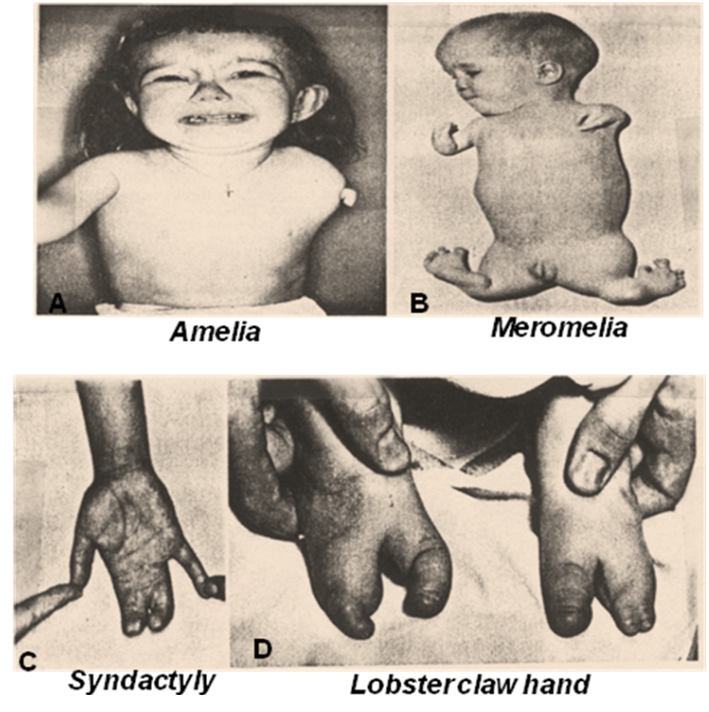
Congenital limb defects (developmental defects):

1. Amelia
  • Early loss of FGF signaling: absence of an entire limb
2. Meromelia
  • Later or partial loss of FGF signaling: absence of part of a limb
3. Phocomelia
  • Partial loss of FGF or HOX disruption short→ poorly formed limb
  • P/D axis defects: Early teratogen → usually limb bud initiation or limb bud elongation defects; earlier time point→ more severe deformity (limb truncations)
4. Ectrodactyly
  • A/P axis defects: too few digits (AER too narrow/deficient)
5. Polydactyly
  • A/P axis defects: too many digits (AER too broad)
6. Syndactyly
  • Defects (MSX2, BMP4) → Soft tissue fusion between digits due (fused digital soft tissue) to lack/insufficient of normal programmed cell death (apoptosis) within the interdigital regions
7. Mirror Image Duplications
  • A/P axis defects: occurs via duplication of ZPA
7935596 orig Limb development in a nutshell
Anomalies of Limbs © 2011 by U. Bala

Also read:

  1. Duke Embryology – Limb Development
  2. Anomalies of Limbs
  3. Embryology.med.unsw.edu.au – Limb Development

Also Watch:

  • Embryology -Limb Development from the Youtube channel “DocvTV”

  • Introduction to Limb Development from the Youtube channel “Kate Lee“

  • Apical Ectodermal Ridge, zone polarizing Activity from the Youtube channel “Nabil Ebraheim”


References:

  1. Sadler TW. Langman’s Medical Embryology. LWW
  2. Dudek. High-Yield Embryology. Wolter Kluwers
  3. Jorde L, Carey J, Bamshad M. Medical Genetics. Elsevier
  4. Saladin KS. Human Anatomy. McGraw-Hill Medical Publishing
siva guru

siva guru

DMA Edu

Copyright © 2017 DMAedu.

Navigate Site

  • About
  • Advertise
  • Privacy & Policy
  • Contact

Follow Us

Welcome Back!

Login to your account below

Forgotten Password? Sign Up

Create New Account!

Fill the forms below to register

All fields are required. Log In

Retrieve your password

Please enter your username or email address to reset your password.

Log In
No Result
View All Result
  • Home
  • About
    • TEAM
    • FACULTIES
    • PARTNERS
  • Exams
    • INDIA
      • FMGE
      • NEET-UG
      • NEET PG
      • NExT
    • ABROAD
      • PLAB
      • USMLE
      • SMLE
      • DHA
  • Courses
  • Products
    • FMGE APP
    • NEET-PG APP
    • USMLE APP
    • DHA APP
  • FREEBIES
    • RESOURCES
    • TESTS
    • APPS
      • FMGE APP
      • NEET-PG APP
      • USMLE APP
      • DHA APP
  • Daily

Copyright © 2017 DMAedu.